Two PhD students to ETOUR in the HERITOUR project
In January, there was a kick-off for the HERITOUR project in Rotterdam, an international initiative to educate doctoral students with expertise in culture, heritage and tourism. Two doctoral students will be part of ETOUR in the program that combines research, practice and global knowledge exchange.
Cultural heritage and tourism face major challenges that are often linked to economic growth. By fostering interdisciplinary expertise and collaboration, the new international HERITOUR project will help shape a more hybrid, resilient and sustainable future for cultural heritage tourism.
HERITOUR is funded by the Marie Skłodowska-Curie Actions Doctoral Network, which is one of the EU's most prestigious doctoral programmes. The project has been granted SEK 33 million, of which the tourism research center ETOUR at Mid Sweden University has been awarded just over SEK 7 million.
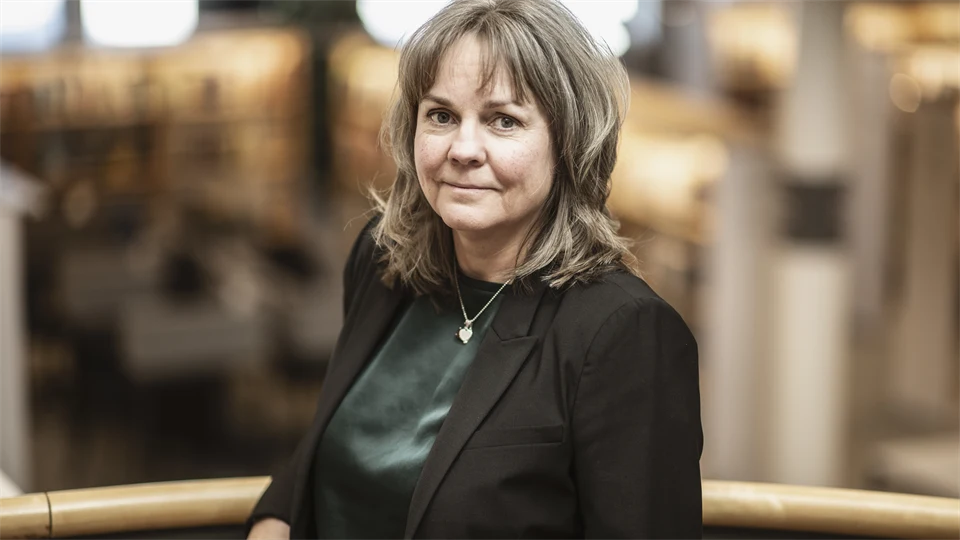
Erasmus University Rotterdam is leading the project, which brings together prominent research environments in cultural and tourism research in the Netherlands, Norway, Sweden, Spain, Turkey and Aruba. Maria Lexhagen is a professor of tourism studies at ETOUR at Mid Sweden University and one of the project participants.
"It feels exciting to be part of a group with such a wide range of different scientific backgrounds and specialist knowledge. I really believe that we will be able to create something new and future-oriented with this project that builds bridges between culture and tourism," says Maria.
Doctoral students gain unique expertise in culture and tourism
The purpose of HERITOUR is to educate a new generation of doctoral students who gain a combined competence to be able to work with culture, cultural heritage and tourism. The ten PhD students admitted to the programme will work on individual dissertation projects linked to four themes: hybridisation, resilience, democratisation and sustainability. Maria Lexhagen will be responsible for the research area of hybridization.
"Hybridization is about the continuous development of digital technologies and how they affect, challenge and change creativity, product and experience development, consumption, management and preservation in local, hybrid and digital environments. The project's Swedish partners, Kalmar Castle and the Sami museum Gaaltije, will collaborate with the doctoral students on this theme, says Maria.
Two new doctoral students to ETOUR
Two of HERITOUR's doctoral students will be placed at ETOUR, where they will be part of an extensive international training program that includes training, internships and exciting study visits. The doctoral students will have the opportunity to build international networks across both geographical and disciplinary borders.
At the end of January, the kick-off for the project was held at Erasmus University Rotterdam. Maria Lexhagen participated together with research colleagues from Europe, the Caribbean and the Middle East.
"It was energetic and inspiring. We planned for the recruitments, for training and collaborations with national and international organizations in the field of culture and tourism. Examples of organizations that we will collaborate with are Europa Nostra, Interpret Europe, Region Stavanger and ARUBA Hotel and Tourism Association," says Maria.
Broadening towards cultural tourism
In Rotterdam, the first steps were taken towards the recruitment of doctoral students. This will take place in 2026 and the project will open up for applications soon. At ETOUR, they are now preparing to receive two new doctoral students. Robert Pettersson, executive director, says that the project contributes to a broadening of the activities.
"At ETOUR we have a long tradition of research and employees who focus on nature tourism. Therefore, it is particularly gratifying that our efforts to increase the number of cultural tourism projects also result in two new positions," says Robert, who is looking forward to welcoming the new doctoral students.
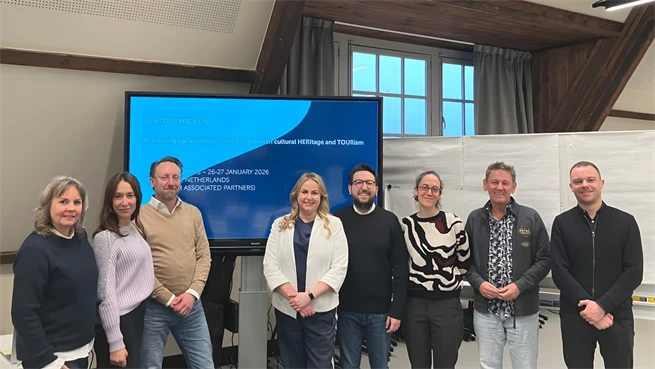
The kick-off for the HERITOUR project took place in Rotterdam in January 2026. Photo: Maria Lexhagen
Contact