PhD student awarded for research on sustainable wood impregnation
Assem Akkuly, PhD student at the FSCN Research Center, has received the Bo Rydin Foundation scholarship for her master's thesis on how turpentine-based microemulsions can provide more sustainable protection of wood against bacteria and fungi.
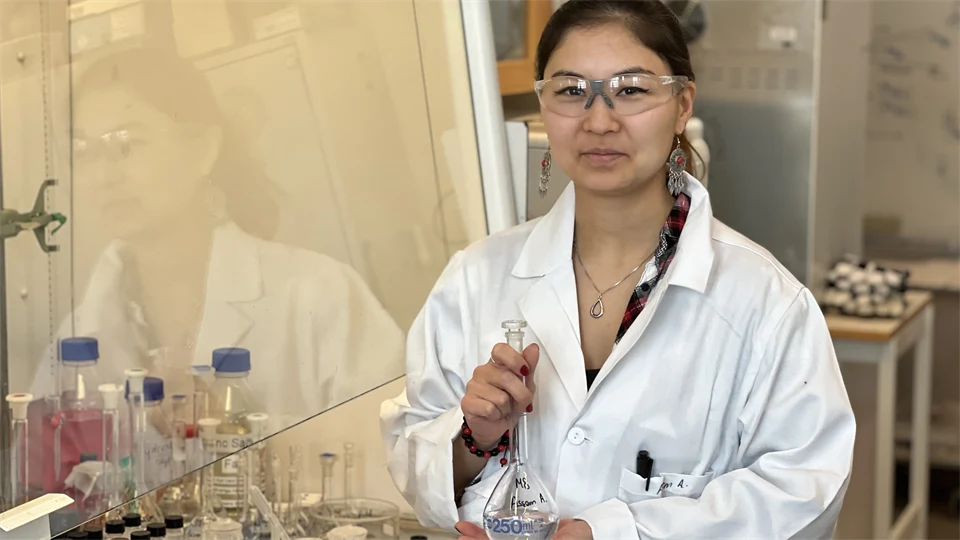
The Bo Rydin Foundation is an industry-related foundation that annually awards scholarships for outstanding degree projects in the forest, pulp and paper fields.
In her master's thesis, Assem has studied how microemulsions based on turpentine – a by-product from the pulp and paper industry – can be used as a more sustainable alternative for wood impregnation. Turpentine has natural antibacterial and antifungal properties, which makes it interesting as a substitute for today's impregnation chemicals, such as creosote and various copper-based substances.
"Turpentine has several promising properties and could be used to prevent wood from decomposing. This makes it a potentially sustainable alternative to the harsh chemicals used today," says Assem Akkuly.
Penetrates the wood
To create a functioning microemulsion, water, salt and various additives are added. The structure of the microemulsion – with very small nanodroplets and low surface tension – allows it to penetrate the wood without the need for high-pressure technology.
When the news of the scholarship came, Assem was both surprised and happy.
"I was shocked when I found out that I had received the scholarship. I didn't dare to expect it, so I feel very honoured.
As a PhD student, Assem is now continuing to work in the same research area as in her master's thesis. The focus is on further developing the microemulsions, including by adding ingredients that can enhance the antibacterial properties.